
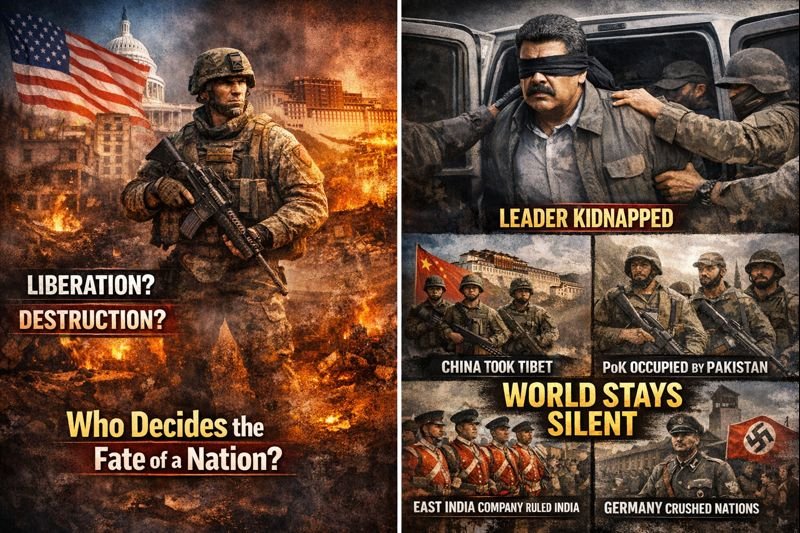
THE NEXT WORLD WAR LOGIC
Opening Reflection: When Civilizations Are Pressured, Not Invaded
Some wounds do not come from bombs. They come from fear that settles into daily life, from the slow shrinking of space to live, worship, speak, and belong. In many parts of the Global South, communities are not conquered — they are exhausted. Economies strain, politics polarize, narratives harden, and suddenly ancient cultures find themselves on the defensive inside their own homelands.
This manuscript examines that quiet pressure through multiple lenses: Venezuela as an early laboratory of modern coercion; Bangladesh and Pakistan as cultural fault lines where minorities — particularly Hindus — experience recurring vulnerability; and the role of Western power, not always as a single hand, but as a system whose tools amplify internal fractures.
The aim is not accusation for its own sake. It is recognition. Because what is not recognized cannot be protected.
Civilizational Memory and the Weight of History
Civilizations do not disappear overnight. They erode. First through economics, then through fear, finally through silence. Hindu civilization — among the world’s oldest continuous cultures — has survived empires, partitions, and forced migrations. Yet in parts of South Asia today, Hindu communities live with a persistent sense of insecurity.
This insecurity is not theoretical. It is experienced as vandalized temples, threatened neighborhoods, coerced silence, and demographic thinning through migration. Each incident may be explained away as isolated. Together, they form a pattern that communities recognize even when states hesitate to name it.
Bangladesh: Pressure on a Fragile Balance
Bangladesh was born from trauma. Partition carved identities with blood, and independence arrived through war. Within this history, Hindu minorities remained — culturally rooted yet politically exposed.
Periods of economic stress and political confrontation have repeatedly coincided with spikes in communal anxiety. When institutions weaken and streets fill, minorities become visible targets — not always by design, but often by consequence.
Fear does not require orchestration. It requires opportunity.
Bangladesh — Minority Stress Indicators
| Domain | Observed Pressure | Human Impact |
|---|---|---|
| Political instability | Polarized legitimacy | Reduced protection |
| Economic stress | Inflation, unemployment | Heightened scapegoating |
| Street unrest | Mob dynamics | Targeted intimidation |
| Narrative warfare | Selective outrage | Silence around minority suffering |
When violence erupts, the first loss is trust. The second is belonging.
Pakistan: Structural Exclusion Becomes Normalized
In Pakistan, Hindu minorities have lived with structural exclusion since the state’s inception. Forced conversions, property seizures, and legal vulnerability are documented realities acknowledged even by domestic civil society.
The danger lies not only in violence, but in normalization. When discrimination becomes routine, outrage fades. When outrage fades, exit begins. Migration becomes the last refuge.
This is not merely a minority issue. It is a civilizational signal.
Pakistan — Minority Reality Snapshot
| Aspect | Condition | Long-Term Effect |
|---|---|---|
| Legal protection | Weak enforcement | Chronic fear |
| Social mobility | Restricted | Economic stagnation |
| Cultural space | Shrinking | Identity erosion |
| Migration trend | Outflow | Demographic thinning |
Cultures do not vanish because they are defeated. They vanish because survival becomes unsustainable.
The Western System: Power Without Cultural Cost Accounting
Western powers rarely see themselves as cultural actors. They see policy, markets, values, and interests. Yet policies do not land in empty spaces — they land in living societies.
Sanctions, diplomatic pressure, selective human-rights advocacy, and media amplification form a system. This system rewards some narratives and marginalizes others. Minority suffering that does not fit strategic priorities often receives polite silence.
This is not always malice. It is instrumental blindness.
When instability serves leverage, instability is tolerated.
Venezuela Revisited: Economic War, Human Cost
Venezuela’s collapse demonstrates how economic tools produce cultural damage. As the economy imploded, social bonds fractured. Migration scattered families. Identity weakened under survival pressure.
Venezuela — Collapse Indicators
| Indicator | Pre-Crisis | Crisis Period | Human Result |
|---|---|---|---|
| GDP | Stable | Severe contraction | Poverty surge |
| Inflation | Manageable | Hyperinflation | Savings erased |
| Oil output | High | Collapse | State paralysis |
| Migration | Low | Massive | Family separation |
Sanctions did not target culture — but culture paid the price.
Intelligence, Influence, and the Grey Zone
Communities across regions believe that unrest is sometimes nudged, not created. Intelligence agencies deny orchestration, yet patterns of information flow, funding pathways, and diplomatic timing raise enduring suspicion.
What matters geopolitically is not courtroom proof, but social belief. When societies believe they are being manipulated, trust collapses faster. Fear multiplies.
The grey zone between truth and perception is itself a weapon.
India: A Civilizational State That Remembers
India views these patterns through deep historical memory. Partition taught India how quickly neighbors can turn unfamiliar. Sanctions taught it how morality is often selective. Pressure taught it the cost of dependency.
India’s response is neither loud nor submissive. It is patient, layered, and autonomous.
India — Strategic Instincts
| Dimension | Approach | Purpose |
|---|---|---|
| Energy | Diversification | Survival |
| Diplomacy | Multi-alignment | Autonomy |
| Culture | Protection without provocation | Continuity |
| Minorities abroad | Quiet advocacy | Safety |
India understands that civilization survives not by shouting, but by enduring.
Why Cultural Destruction Is the Most Dangerous Weapon
Destroy an economy and it can be rebuilt. Destroy a culture and recovery takes generations. When communities are pushed into fear, silence, or exile, something irretrievable is lost.
The modern world rarely names this loss. It prefers metrics over memory.
But civilizations are not numbers.
Closing Reflection: What Must Be Seen to Be Saved
Hindu communities in Bangladesh and Pakistan do not ask for dominance. They ask for dignity.
Venezuela’s people did not ask to become an experiment. They asked for stability. The modern global order often speaks of values while practicing leverage. It forgets that cultures are not tools.
If the next world war is already unfolding, it is unfolding here — in kitchens without food, temples without safety, neighborhoods without trust.
Those who see this early may still protect what matters.
Those who dismiss it will one day ask how civilizations disappeared without a single declaration of war.



Comments (0)
Join the discussion. Login to comment