
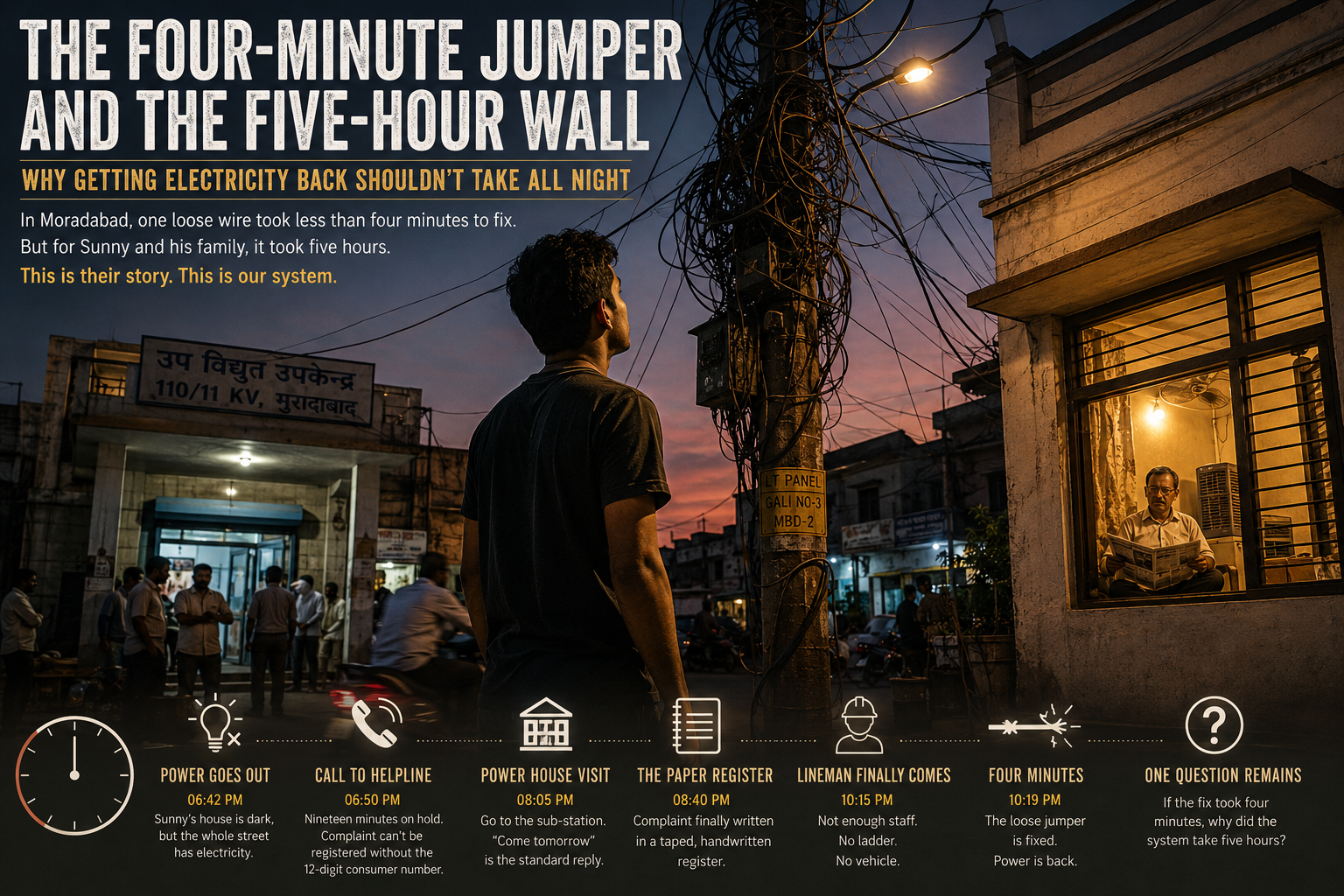
The Four-Minute Citizen: A Tier-2 Symphony of Chaos
Chapter 1: The Digital Mirage
It was 6:30 PM on a Tuesday. The heat in the alleyways was thick enough to chew, hovering around an aggressive 34°C with zero wind. Sunny had just stepped out of the shower, reaching for his towel, when the world suddenly died.
The ceiling fan did that slow, agonizing, squeaking spiral to a dead stop. In the corner, the inverter let out a single, pathetic, high-pitched beep of absolute exhaustion and went completely blind. The battery was dead—fried by the six hours of unpredictable rolling cuts earlier that afternoon.
Sunny stepped out onto the porch, wiping grease and sweat from his neck. The streetlights outside were humming happily.
Across the narrow concrete lane, his neighbor, Sharma ji, was sitting like a king on a white plastic Nilkamal chair. He was positioned directly under a blazing, perfectly functional 20-watt LED bulb, calmly flipping through the evening Hindi newspaper while his desert cooler blasted a frosty draft onto the asphalt.
"Humare yahan toh aa rahi hai, Sunny beta," Sharma ji announced with a tiny smirk, not even bothering to look up from the sports page. "Tumhara hi kuch udi hogi patti (fuse). Secondary phase chala gaya hoga tumhara."
Right. It wasn’t a systemic power outage. It was a targeted, deeply personal attack by the state distribution grid.
Like any modern, educated, tech-savvy citizen of a country aggressively branding itself as a global digital superpower, Sunny pulled out his smartphone to lodge an official complaint online.
[DISCOM APP - LOADING...]
Error 504: Gateway Timeout.
The central server failed to route your request. Please try again later.😂😂😂😂😂😂
Sunny muttered a curse, cleared the application cache, and hit [TRY AGAIN].
The screen flickered. "Please enter the One-Time Password (OTP) sent to your registered mobile number."
He waited. Two minutes. Five minutes. The ambient temperature in the room felt like it was climbing by a degree every sixty seconds. The OTP finally arrived via SMS eleven minutes later with a joyful ping. By then, the security token had expired. The screen flashed a bright red: Session Timeout. Start Over.
He gave up on the app and dialed the 5-digit Customer Care helpline. He fought his way through the automated robotic maze: Press 1 for Hindi. Press 2 for English. Press 3 for Billing. Press 9 to talk to our grievance executive.
A cheery, synthesized lady voice chimed through the speaker: "Aap qatar mein hain (You are currently in queue). Your estimated waiting time is... twenty-four minutes. Thank you for your patience."
When a weary human voice finally picked up through a cloud of heavy static, Sunny explained the issue with a polite, desperate tone. The executive, sitting in a perfectly air-conditioned corporate cubicle five hundred kilometers away, responded with absolute, frozen bureaucratic politeness:
"Sir, please provide your 12-digit Consumer Account Number."
Sunny froze. Who on earth has a 12-digit utility account number memorized in pitch darkness while sweating through their domestic vest?
"Bhaiya, consumer number nahi hai abhi darkness mein. Naam, meter number, aur address se check kar lo please?"
"Sorry sir, our new upgraded system does not accept complaints without a validated consumer number. Please locate a physical copy of your previous bill and call us back. Standard complaint resolution time will be 4 to 10 hours after successful registration."
Four to ten hours. For a loose wire. Sunny looked back into his pitch-black living room. His mother was trying to chop ridge gourd by the trembling, weak light of a fading smartphone screen. The local neighborhood mosquitoes were already organizing an emergency welcoming committee around his ankles.
Chapter 2: The Temple of Moods
"Customer care se ghanta kuch nahi hoga," his father muttered from the darkness of the wooden cot, rhythmically waving a crude hand-fan hacked out of an old cardboard shirt-packaging box.
"Yeh upar waale sab AC mein baith ke system-system khelte hain. Seedha Bijli Ghar jao. Aur suno... bina register mein naam likhwaye wapis mat aana. Unke computerized systems sirf unki screen par chalte hain."
Sunny kicked his bike to life, the headlamp cutting a weak yellow beam through the dusty air, and rode down the broken road to the local Sub-Station.
The local Bijli Ghar is not a functional public utility office; it is a sacred temple dedicated entirely to the volatile, changing moods of underpaid men. It was a decaying, jaundiced-yellow concrete block hidden behind overgrown weeds and discarded rusted transformers.
A single naked tubelight flickered on the porch, surrounded by a dizzying cloud of summer insects. Three rusted motorcycles sat slumped under a neem tree. A government Mahindra Bolero, covered in three thick inches of official state dust, sat parked in the corner with a flat tire.
Inside the humid room sat Clerk Number 1. He was slowly chewing paan, staring intensely at a massive, brown, leather-bound manual register that looked older than the Indian Constitution.
"Bhaiya, Civil Lines, Gali Number 3. Pure mohalle mein light hai, bas humare ghar ka jumper ud gaya hai."
Clerk Number 1 didn't even look up. He spat a dark stream of paan juice into a small plastic cup hidden under the desk, turned a massive page with a dry rasp, and said, "Consumer number?"
"Nahi hai bhaiya, light nahi hai ghar pe, computerised bill kaise nikalun?"
The clerk finally raised his eyes and stared at him. This was the ultimate Tier-2 gamble. Depending entirely on whether his local cricket team was winning, or if his evening sweetened tea was hot enough, the clerk would either kick Sunny out onto the street or show divine mercy.
Tonight, he was simply bored. He pushed a separate, thinner register forward. Its spine was held together by layers of decaying brown packing tape. A blue ballpoint pen, cracked down the middle and wrapped tightly in black electrical tape, was tied to the desk frame by a dirty nylon string.
"Likh do."
Sunny quickly scrawled his details across the hand-drawn columns: Serial Number 412. Name, Phone Number, Gali Number 3, Supply Failure.
"Bhaiya, iska koi ticket number? Receipt? Kab tak thik ho jayega?" Sunny asked, trying to peer into the ledger.
The clerk closed the massive book with a heavy thud that raised a small cloud of grey dust. "Abhi gaadi nahi hai, aadmi bhi nahi hai. Sab line check karne gaye hain bypass par. Aayenge toh bhejenge."
No SMS confirmation. No digital ticket tracking. Just a single line of fading blue ink in a physical book that could be closed, slide under a desk, and forgotten forever.
Chapter 3: The Great Escape (The "Hum Toh Aaye The" Phenomenon)
Sunny rode back home. He sat on a plastic stool on the pavement and waited.
One hour passed. Then two. The concrete walls of the house were vibrating, radiating the intense heat they had soaked up during the afternoon sun. Inside, his sister Priya was trying to study for her terminal chemistry board exams under the flickering, smoky flame of a wax candle, her face completely shiny with sweat.
By 8:30 PM, the absolute ridiculousness of the situation broke him. Sunny rode back to the power house, his throat dry from the dust.
The shift had changed. Clerk Number 1 was gone, likely sleeping under a cooler at home. In his place sat Clerk Number 2, a younger man with a thick beard, happily eating paranthas from a multi-tiered steel tiffin box while scrolling through short videos on his phone.
"Bhaiya, gali number 3... do ghante pehle complaint likhwayi thi serial number 412 par. Abhi tak koi nahi aaya."
Clerk Number 2 stopped his spoon mid-air, looking annoyed. "Kaunsi complaint? Mere shift mein koi civil lines ki complaint nahi aayi hai."
"Ussi register mein likhi hai! Aapke pehle jo desk par baithe the unhone khud likhwayi hai!" Sunny’s voice cracked with raw, unedited frustration.
Clerk Number 2 lazily pulled the taped register toward his tiffin box, flipped three pages backwards with a greasy thumb, and tapped the paper.
"Achha... yeh wali? Arrey bhai, iska toh aadmi gaya tha. Humare linemen hoke aaye hain wahan se."
Sunny stared at him, utterly bewildered. "Hoke aaye hain? Main pichle do ghante se ghar ke bahar main road par macchar marwa raha hoon! Mere gali mein koi sarkari gaadi ya lineman nahi dikha!"
The clerk shrugged with supreme, untouchable, administrative confidence. "Aaye honge. Aap hi ghar pe nahi hoge. Lineman gaya hoga, usne dekha hoga ghar band hai ya rasta block hai, toh wapis aa gaya. Entry check kar lo."
This is the ultimate masterpiece of North Indian bureaucratic gaslighting: The "Hum Toh Aaye The" Phenomenon. You could be standing directly under the electric pole for three straight hours without blinking, but according to the spiritual ledger of the sub-station, a phantom lineman arrived, scanned the environment, diagnosed the universe, and vanished back into thin air.
Sunny took a deep, shaky breath, clutching the edge of the wooden partition. "Bhaiya, main wahi tha. Mere pure mohalle ke log sadak par baithe hain garmi mein. Chalo mere saath abhi."
Clerk Number 2 waved his greasy hand dismissively. "Hum kaise chalein? Humara kaam thodi hai khambhe par chadhna. Hum toh desk par hain. Linemen aayenge toh unse baat karna."
Right then, his father’s golden rule of urban survival flashed in his mind:
"Beta, desh mein 5G aa jaye ya 6G... jab bijli jaye na, toh lineman ko apni bike par peeche bitha kar khud ghar lekar aana. Agar usne bola 'Tum chalo, main peeche se jeep mein aa raha hoon', toh samajh lena tumhari raat kaali hone wali hai. Woh kabhi nahi aayega."
Sunny stood his ground. He refused to leave the room. He waited until 9:15 PM, until two exhausted linemen finally rolled into the compound on an old, sputtering Bajaj Chetak scooter, smelling heavily of local bidi and strong ginger tea.
Sunny literally intercepted them at the rusted iron gate, blocking their path. "Bhaiya, gali number 3. Bachi ka board exam hai kal subah. Chalo. Main chhodunga apni bike par, main wapis chhod ke jaunga sub-station. Bas aap chalo."
The two linemen exchanged a weary look, sighed in unison, and muttered, "Chalo bhaisaab, aafat hai har jagah."
Chapter 4: The Weaponless Army
They reached the corner of Gali Number 3. The older lineman got off the bike, stretched his back, and pointed his small plastic flashlight up into the dark, chaotic mass of cables. He looked at the transformer, looked at the wire, and then turned around to face Sunny.
"Seedhi hai?"
Sunny’s brain briefly disconnected from reality. "Kya?"
"Seedhi bhai. Ladder. Khambhe pe chadhne ke liye bamboo wali ladder."
Sunny felt a vein throb in his forehead. "Seedhi? Aap log state electricity department se aaye ho pole thik karne... aur aapke paas apni ladder nahi hai?!"
The younger lineman scoffed, deeply irritated that an ordinary consumer was questioning their field logistics.
"Arrey bhai, dimag mat khao garmi mein. Gaadi dusri site par gayi hai bypass ka panel thik karne, saari badi extension ladders ussi ke upar bandhi hain. Ab kaam karwana hai toh batao, aas-paas kisi shopkeeper ya tent-house wale se maang kar lao. Nahi toh subah gaadi aayegi tab dekhenge."
Think about the sheer, mind-numbing absurdity of this setup. The state electricity distribution apparatus—an agency responsible for thousands of megawatts and complex regional grids—sends its core tactical strike force to repair a live main line with absolutely zero structural equipment. It is exactly like a soldier showing up to a high-stakes battlefield, knocking on a civilian's door, and asking if they have a spare rifle he can borrow for an hour.
Desperate, drowning in his own sweat, and running entirely on adrenaline, Sunny had to run three blocks down the main market road to a local wedding tent-house supplier.
He had to beg the guard, sign a personal guarantee note, lift a heavy, splintering, 15-foot bamboo ladder onto his own bare shoulder, and drag it across the main intersection like a cross, finally propping it unevenly against the concrete power pillar.
Chapter 5: The Four-Minute Joke
The older lineman pulled a pair of cracked, thick black rubber gloves from his canvas bag and scaled the bamboo ladder into the dark, terrifying maze of overhead cables.
He secured his slippers against a bamboo rung, pulled a pair of rusted iron pliers from his pocket, stripped a thick piece of scrap aluminum wire he found lying on the road, twisted it around the blown terminal jumper, and wrapped exactly two quick rounds of black insulation tape around the joint.
"Jao, neeche se main switch uthao!" he yelled down into the dark lane.
Sunny sprinted into his corridor and slammed the heavy iron lever upward on the main distribution box.
BZZZZT.
With a sharp, aggressive electric buzz, the entire house exploded into beautiful, brilliant white light. The ceiling fan shook violently, cleared its throat of five hours of dry dust, and began to spin at full, glorious speed, throwing down heavy sheets of moving air.
In the living room, Priya looked up from her melting candle, her textbook instantly illuminated by the tubelight.
Sunny walked back out to the pavement. The lineman was already climbing down the ladder, casually tucking his rusted pliers back into his canvas belt.
- Total time the specialist spent on top of the pole executing the technical repair: 3 minutes and 45 seconds.
- Total duration of the family's blackout: 5.5 hours.
Five and a half hours of a total hot blackout. Two high-speed trips to the power house in the suffocating heat. Two exhausting arguments with indifferent clerks. One phantom lineman entry. One heavy bamboo ladder carried on his own shoulders. All for a mechanical fix that took less time than boiling a packet of instant noodles.
The older lineman walked into the bright yellow glow of Sunny's porch light, wiping gray grime and sweat from his neck with a checkered cotton cloth.
He looked at the cool air blowing out of Sunny’s window, looked down at his own dirty boots, and rubbed his thumb against his index finger in a universal, time-tested gesture.
"Aur batao, Sunny bhai... raat ke barah baj rahe hain. Shift khatam hone ke baad bhi ruk gaye aapka kaam karne. Kuch chai-paani ka dekh lo (Take care of our hospitality)."
The crowning glory. The tip. The soft bribe disguised as social tea manners. You know the unwritten rules of the town: if you don't hand it over with a smile, your complaint will miraculously slide to the absolute bottom of the taped ledger next time, or your service wire will "accidentally" snap again during the next heatwave.
Wishing to ensure his sister could finish her organic chemistry chapters in absolute peace, Sunny reached into his pocket, pulled out a crumpled, damp 100-rupee note, and handed it over.
"Thank you, bhaiya," Sunny said, his voice entirely flat.
The two linemen smiled broadly, tucked the note away, hopped back onto their old Bajaj scooter, kicked the engine into a loud rattle, and disappeared into the midnight dust.
The Million-Dollar Question
Sunny stood under the fast-moving fan, watching his mother go back to the kitchen counter while his sister wrote rapidly under the steady glare of the tubelight. The domestic friction had dissolved completely, leaving no physical trace behind.
But Sunny stood by the water cooler, holding a steel tumbler, looking down at a small red bruise on his shoulder where the borrowed wedding ladder had rested.
We talk endlessly about digital governance. We celebrate smart cities, automated billing, unified portals, and becoming an economic superpower. But the everyday structural reality of the Indian citizen is still locked inside a leather register with a ballpoint pen tied to a piece of string.
If fixing the actual, physical problem takes less than four minutes... why does the administrative system require five hours of human humiliation just to set those four minutes in motion?
Who really holds the power in a digital nation—the citizen who pays the automated electronic bills, or the underpaid man who commands the bamboo ladder?




Comments (1)
Join the discussion. Login to comment
Nice article