
.jpg)
Since independence in 1971, Bangladesh has experienced a recurring political cycle marked by periods of relative stability and economic growth followed by mass protests, political collapse, and the re-emergence of Islamist forces. These cycles have repeatedly undermined democratic institutions, destabilized the economy, and disproportionately harmed religious minorities—especially Hindus—whose population has steadily declined from approximately 30% in 1947 to under 8% today. While international commentary often frames these moments as spontaneous “youth-led revolutions” or routine democratic corrections, a closer examination reveals consistent ideological and organizational patterns tied to Islamist networks, particularly Jamaat-e-Islami and its political allies, whose roots trace back to Pakistan’s radical political ecosystem.
This paper documents these cycles, preserves factual tables and figures, and situates recent events (2024–2025) within a broader historical continuum.
1. Origins of the Cycle: Independence and Early Betrayals (1971–1975)
Bangladesh emerged from the 1971 Liberation War as a secular republic under Sheikh Mujibur Rahman. The war itself was marked by mass atrocities, including targeted killings of Hindus, intellectuals, and pro-independence activists by Pakistani forces and their local collaborators—most notably Jamaat-e-Islami and its paramilitary wings, Razakar and Al-Badr.
The post-war constitution enshrined secularism, nationalism, democracy, and socialism. However, the institutional foundations of the new state were fragile. Economic devastation, famine, and political instability created openings for counter-forces that rejected the very idea of a secular Bengali nation-state.
The assassination of Sheikh Mujibur Rahman in 1975 was not merely a coup—it was a decisive rupture that allowed Islamist actors, previously banned for collaboration during the war, to re-enter political life.
2. Historical Rise–Fall Cycles
The following table summarizes Bangladesh’s major political phases and illustrates how each period of stability was followed by decline, often coinciding with the reintegration or empowerment of Islamist groups.
Table 1: Political Rise–Fall Cycles in Bangladesh
| Period | Leader / Regime | Key Rise Factors | Fall Triggers | Islamist Role |
|---|---|---|---|---|
| 1971–1975 | Sheikh Mujibur Rahman (Awami League) | Liberation victory; secular constitution | 1975 assassination | Jamaat opposed independence; aided Pakistan |
| 1975–1981 | Ziaur Rahman (BNP) | Economic liberalization; ~5% GDP growth | 1981 assassination | Jamaat ban lifted; Islamists integrated |
| 1991–1996 | Khaleda Zia (BNP–Jamaat) | Privatization; donor inflows | Election violence; minority attacks | Jamaat coalition partner; pogroms |
| 2001–2006 | Khaleda Zia (Four-Party Alliance) | Garment export surge | Caretaker govt intervention | Jamaat ministers oversaw Hindu exodus |
| 2009–2024 | Sheikh Hasina | 6–7% GDP growth; infrastructure boom | 2024 quota protests | Jamaat banned; backlash narratives |
| 2024–Present | Yunus Interim Govt | Reform promises | Stagnation; renewed violence | Jamaat ban lifted; radical inclusion |
3. Economic Growth Under Stability (2009–2024)
Sheikh Hasina’s tenure from 2009 to 2024 represented Bangladesh’s longest uninterrupted period of political stability since independence. During this time:
- GDP per capita rose from approximately USD 543 to USD 2,824
- Services accounted for roughly 51% of GDP
- Industry expanded to nearly 38% of GDP
- Infrastructure investment accelerated across transport, power, and digital sectors
Despite these gains, political space narrowed and dissent was often suppressed, creating latent frustrations—particularly among youth facing underemployment.
4. The 2024 Uprising: From Protest to Political Collapse
4.1 Origins
The 2024 uprising began on July 1 with student protests against public-sector job quotas that reserved nearly 30% of positions for descendants of freedom fighters. Critics argued the system favored ruling-party loyalists at a time when youth unemployment hovered around 40%.
4.2 Escalation
Clashes intensified through July, culminating in nationwide unrest by early August. On August 5, protesters stormed Ganabhaban, forcing Sheikh Hasina to resign and flee to India. Approximately 300 deaths were reported during the unrest.
4.3 Islamist Exploitation
While the protests were not initially ideological, Islamist groups rapidly mobilized once state authority weakened. The interim government under Muhammad Yunus lifted bans on Jamaat-e-Islami and Islami Chhatra Shibir, echoing earlier historical reversals.
5. Detailed Timeline of the 2024 Crisis
Table 2: Key Events of the 2024 Uprising
| Date | Event | Casualties / Impact | Islamist Angle |
|---|---|---|---|
| Jul 1, 2024 | Quota bill passed; protests begin | Arrests at Dhaka University | Student–Chhatra League clashes |
| Jul 15–18 | Violence escalates | 11 killed; internet blackout | Army deployment |
| Jul 29 | Non-cooperation movement | Resignation demands | Jamaat mobilization |
| Aug 4 | Deadliest day | 100+ killed | Mosques used as logistics points |
| Aug 5 | Hasina resigns, flees | PM residence looted | Islamist flags visible |
| Aug 8 | Yunus sworn in | Reform pledges | Jamaat ban lifted |
| Aug 4–20 | Anti-Hindu riots | 2,010 attacks | BNP–Jamaat mobs |
6. Economic Boom–Bust Patterns
Table 3: Economic Indicators Before and After the 2024 Uprising
| Year | GDP Growth (%) | Inflation (%) | Unemployment (%) | Key Event |
|---|---|---|---|---|
| 2021 | 6.94 | ~6 | 5.2 | Infrastructure expansion |
| 2022 | 7.1 | 6.2 | 5.3 | RMG exports peak |
| 2023 | 6.03 | 9.0 | 3.51 | Pre-uprising stability |
| 2024 (post-Aug) | ~3.5 (est.) | 11.38 | Youth ~40 | Industrial disruption |
| 2025 | 2.3–3.3 | 8.29 (Nov) | +2.1M jobs lost | Reform stagnation |
7. Hindu Persecution: Demographic and Statistical Evidence
Hindus in Bangladesh have faced systematic marginalization, periodic violence, and forced migration for decades.
Table 4: Decline of Hindu Population in Bangladesh
| Year | Hindu Population (%) |
|---|---|
| 1947 | ~30 |
| 1971 | ~22 |
| 1991 | ~12 |
| 2011 | 8.5 |
| 2022 | 7.95 |
8. Post-2024 Surge in Violence Against Hindus
Table 5: Documented Anti-Hindu Violence
| Period | Attacks | Damage | Casualties |
|---|---|---|---|
| 1971 War | Mass genocide | Temples, homes destroyed | 200k–3M total deaths |
| 2001–2006 | Thousands | Widespread | Hundreds killed |
| Aug 4–20, 2024 | 2,010 | 69 temples; 157 homes; 103 businesses | 5 deaths |
| Nov 2024–Jan 2025 | 76 incidents | 152 temples | 23 deaths |
| Jan–Mar 2025 | 142 cases | 13 temples | 5 murders; 8 rapes |
9. Case Study: Dipu Chandra Das (2025)
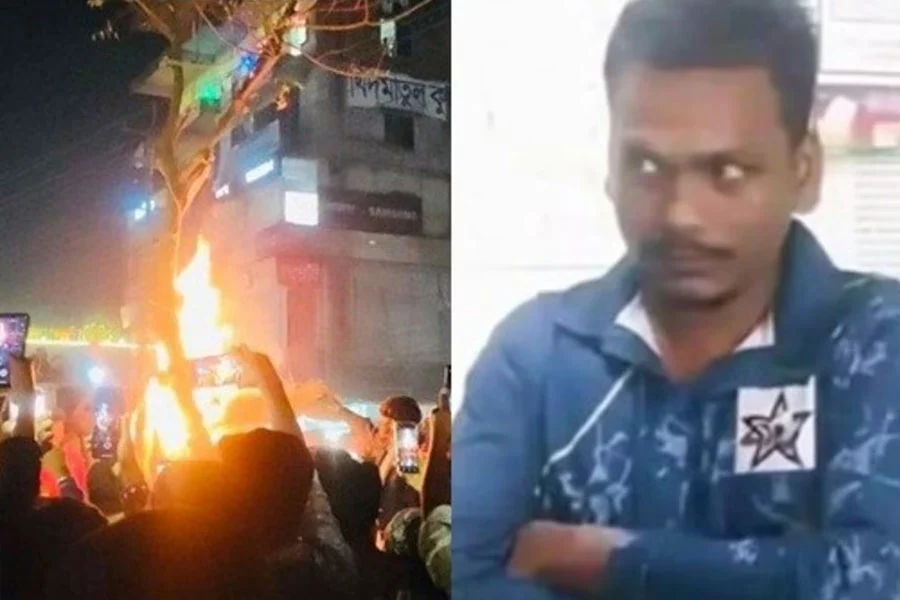
On December 18, 2025, Dipu Chandra Das, a 25-year-old Hindu garment worker in Mymensingh, was lynched by a mob following unverified allegations of blasphemy. Despite police awareness and employer intervention, the mob dragged him from his workplace, assaulted him, and burned his body.
This incident illustrates the collapse of rule of law under conditions of ideological emboldenment.
10. Interim Government Under Muhammad Yunus: Reform vs. Reality
The Yunus administration announced six reform commissions covering elections, police, and judiciary. Economically, it adjusted tax systems and responded to labor demands. However, reports documented:
- Over 272,000 arbitrary arrests
- Custodial deaths
- Continued impunity for attacks on minorities
11. Global Misreading of Bangladesh’s Crisis
International narratives frequently describe Bangladesh’s turmoil as a democratic “reset,” overlooking Jamaat’s historical role in war crimes and contemporary mobilization. Pakistan-linked networks remain under-scrutinized, while regional instability grows.
12. Path Forward (To Be Expanded in Part 2)
Sustainable recovery requires:
- Inclusive elections
- Firm limits on extremist groups
- Guaranteed minority protections
- Economic stabilization without ideological appeasement
END OF PART 1




Comments (1)
Join the discussion. Login to comment
nice